
Documentation as Composition
on being a "recording artist," and Shelter is out today
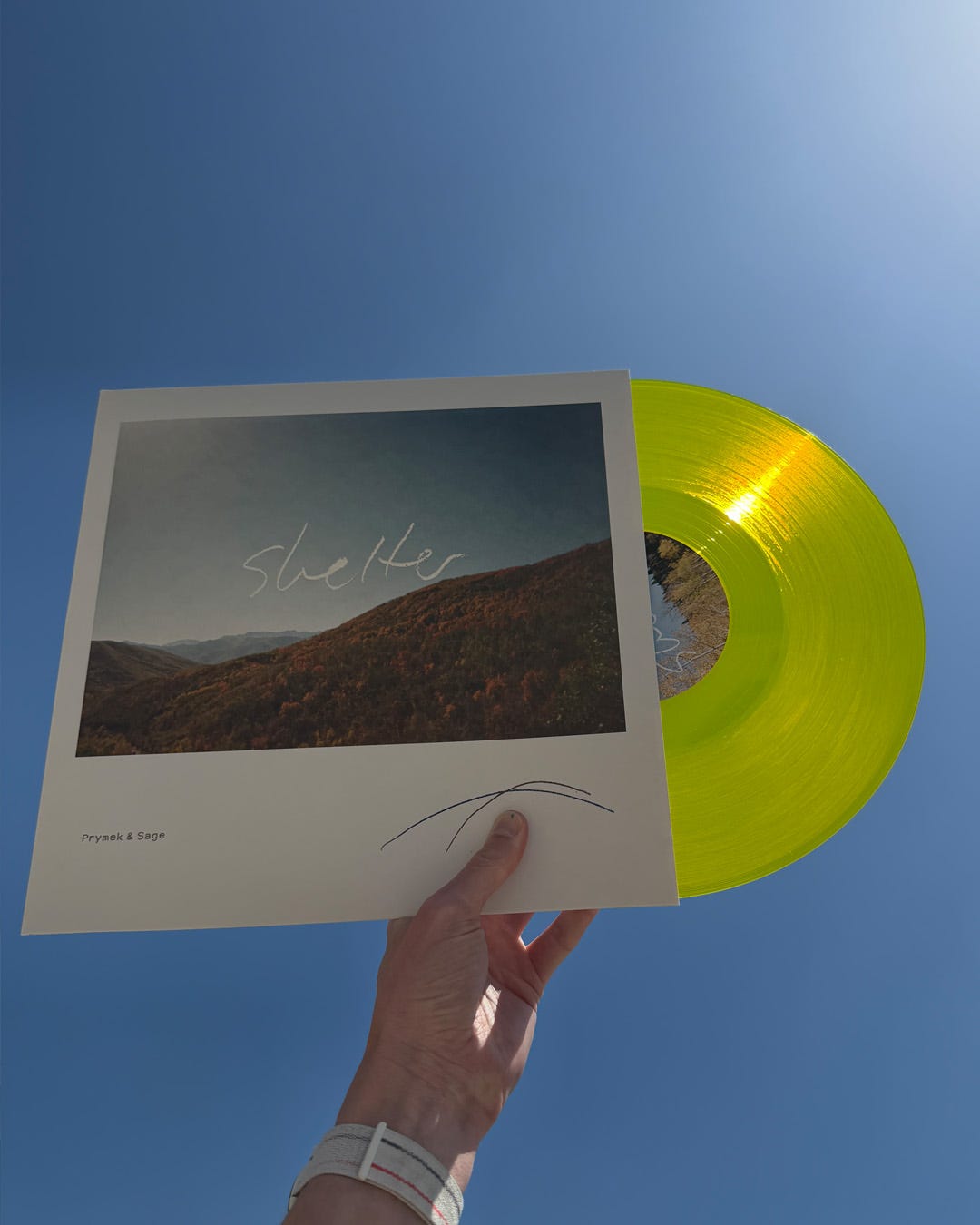
Writing with an announcement about a new album and another one of these little internet essays I’ve been making here.
The album is called Shelter by Prymek and Sage and it is out today on AKP Recordings. Scott Osgood from AKP took that photo of the record up above (and also helped shepherd this thing into existence), I designed it, Chaz took the photo on the cover, Sean McCann mastered it. It has felt like a slow and steady team project and we are so happy to share it with you all today.
To celebrate, I am doing this thing I keep finding myself wont to do; I am no longer operating as an educator but I don’t really know how to cork it, so my care for and thoughts on making, on learning, on being engaged in the culture of creating things have found an outlet here.
Today’s essay/thing started as an assignment I created, but I think that assignment started as a thing I have been doing intuitively in my creative practices since I was a teenager. That thing I have been doing is hitting the “record” button right before me or me and a group of collaborators work together to hit a flow state.
DOCUMENTATION AS COMPOSITION
or, some thoughts on what it means to be a “recording artist”
I know so many musicians that don’t “write music” but they are phenomenal composers. Some of them would curdle to ever hear me say they “write” music. Not because they are strictly improvisers, but because “writing music” can sometimes feel borderline classist… and people outside that dominant (or sheet-music-literate) class can sometimes have an understandable chip on their shoulders. Many musicians that came up in the underground, in punk or indie, or thoroughbred basement avant garde-ists, or those “I learned music with chord charts in church bands” types, or traditional porch musicians from the folk tradition, or any combination of such qualifiers, maybe don’t really have a formidable grasp on theory or sheet music and notation. They may know chords and tabs and charts, sure, but they couldn’t do much with a page of sheet music.
As a self-identifying non-sheet-music-literate musician, my illiteracy has proven, on several occasions, to be a ceiling through which I cannot pass through. I’m not sulking about it… but yeah, there are some gigs where you need to be able to play off sheet music! And I cannot do those gigs.
And yet I make songs, songs become songs, I compose compositions; they are not written, they are recorded. Many musicians I know compose music by recording it. They record in their own unique workflow in their home/bedroom studio, or the basement practice space, or on their laptop at their desk between emails, or on their phones on the bus. They don’t write out charts or parts on the staff; they build songs by layering recordings. Most of them don’t even use traditional studios too much anymore.
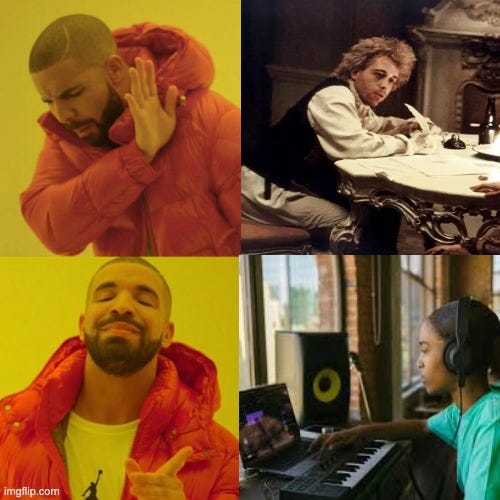
When we imagine a tortured composer toiling over a piece of music, the composer is most likely sitting at a piano with a giant feather quill scribbling notes on staffed paper… from there, there was a George Martin turned sort of California Phil Spector/Rick Rubin studio producer guy archetype too, which is a fascinating thing that is worth thinking about to… but I think both of those archetypes are borderline obsolete now. Home recording technology became so powerful, so accessible, so culturally valued, and it now seems like many people compose by pouring their ideas into a DAW on their own. I am here to confirm I am one of those people.
I have had that phrase “recording artist” stuck in my head for a few months. My arts practice is really fluid and I am always up to something, but using this word “recording artist” feels like a really cohesive way to sum up so much of what I do. I work with recordings. I record sounds, I record images (photo and video), I make graphic design for recordings. Even when I am drawing and painting and doing sculpture it somehow feels more like a recording, like documentation. Then, too, I scan those drawings into the computer, a recording of a recording, and then I use the scan as a layer in a design for the packaging for a sound recording. Then the designed sound recording object is manufactured and shipped to me and I take a picture of that object, and document it, and then sell those objects on the internet. A palimpsest of creation, recording, composing, documenting, sharing.
When I was teaching a college digital arts class I made an assignment called “Documentation as Composition.” The aim of the project was to create a new and original physical artwork in any accessible physical medium (painting, drawing, photograph, sculpture) and to also create a record (or recording) of how that object came to be. It was an invitation to create, but also to document one’s process. Students were to present a 3-5 minute time-based media clip (audio and/or video) that showcases their process, their approach, their studio time. It could be as abstract or as literal as they wanted it to be, so long as the connection between the Documentation and the Composition was clear. I said “I want to feel the two things communicating as we stand in the gallery with both of them.” Often students would present a drawing on the wall and a video time-lapse of the drawing being created (usually in their dorm room); sure! That works! We would often notice new patterns in the artists’ processes by seeing the project being created at high speed. A valuable insight into process! Also, sometimes things would become radically not that approach. Students would go into the deep end and we would see an impressionistic drawing of a river scrawled on a sheet tacked to the wall, but then a 5 minute short film about how a river changes course and how that is a mark on a landscape, and a mark that can be mimicked. Performance, spoken word and recorded sound, moving image, time based and durational, material, archival… an ecosystem of components.
This project was massively inspired by the work of Andy Goldsworthy. I would screen Rivers and Tides (youtube below) every semester before we started this project. I love Goldsworthy because he is a technical and formalistic wizard who can use pretty mundane materials to make dramatic, emotive, and aesthetically compelling artworks. Sometimes formalism feels cold or institutional, but this isn’t that kind of formalism. He is also intentionally not super precious with his work; his work is designed to disappear, to deconstruct and decompose, to blow away, to vanish with a tide. The assignment inspiration comes less from Goldsworthy’s physical artworks though, and more so encourages students to reconsider their relationship to documentation. Goldsworthy is a sculptor, but he is also a photographer, or he had to become a photographer in order to document his works. Without documentation, his work wouldn’t hold up in the academy… because it was in a bog in Scotland rotting and not in a gallery or institution. His works are sculptures, temporary ones, that are documented by means of photography, or in some cases cinema. There, they become archival. Many of us will never be in the presence of a physical Goldsworthy, and yet images capture recordings of these works, and are a work themselves. Without the photographs/cinema, many of the works are practically nonexistent. He had to become a documentarian in order to help expand the scope of what “sculpture” can be in the academy.
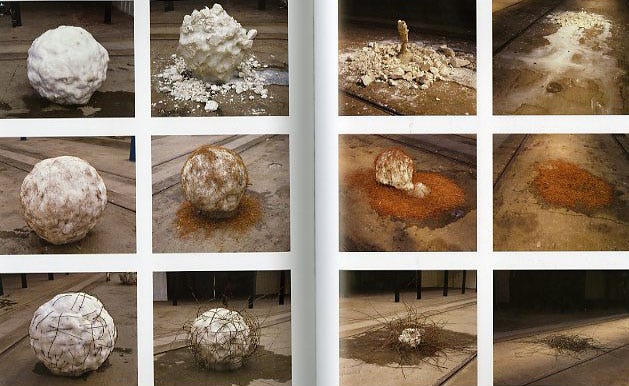
After establishing his work operating in this way, Goldsworthy was eventually invited into the gallery to decompose in real time inside the academy. An installation of a snowball melting over a duration in a gallery, but also a sequence of photographs documenting the snowball melting over time mounted on one spread of a book.
From where I stand, musicians (and all artists really) are faced with this incredibly complicated relationship with “recording” now because it is never quite clear if we should always be recording, or if that is our work to do, or if we should be doing all this work at once. Potters video themselves throwing pots to watch their form. Film makers hire crews to document the film being filmed. Painters reveal their paintings into forward facing cameras to post to share…
Especially improvisers, generative music makers, sound explorers… our practice is one that is built on stumbling into something exciting, sometimes on accident, and being in that ephemeral and fleeting confluence of sound and instrument and player as long as it lasts. A flow state. To catch a sliver of those fleeting and flowing moments… that is what my practice is. You have to get there first, to the stream. This is a thing I learned from Goldsworthy. There are sacred hours in my studio that exist without being recorded, and they remain sacred in their fleeting. Sometimes we are Goldsworthy wandering through the woods making beautiful sculptures that no one will ever see (or hear) ever again. And sometimes I think that fleeting mode is crucial to being a great musician. There are some sounds that only the musician gets to hear as we trample through the briars looking for the right stones to use in our piles.
And yet, sometimes the act of self-archival recording is also one of the most essential acts of creation for me. Capturing a fleeting moment, preserving it, and turning it into the core of a thing, a document of a thing. And so, Documentation becomes Composition.
I don’t have answers for your practice, or how to find that magic cache of stones, apart from just suggesting I have found it useful to consider my relationship to making as both a Documentarian and as a Composer. Working to consistently find the stream and knowing when to hit record.
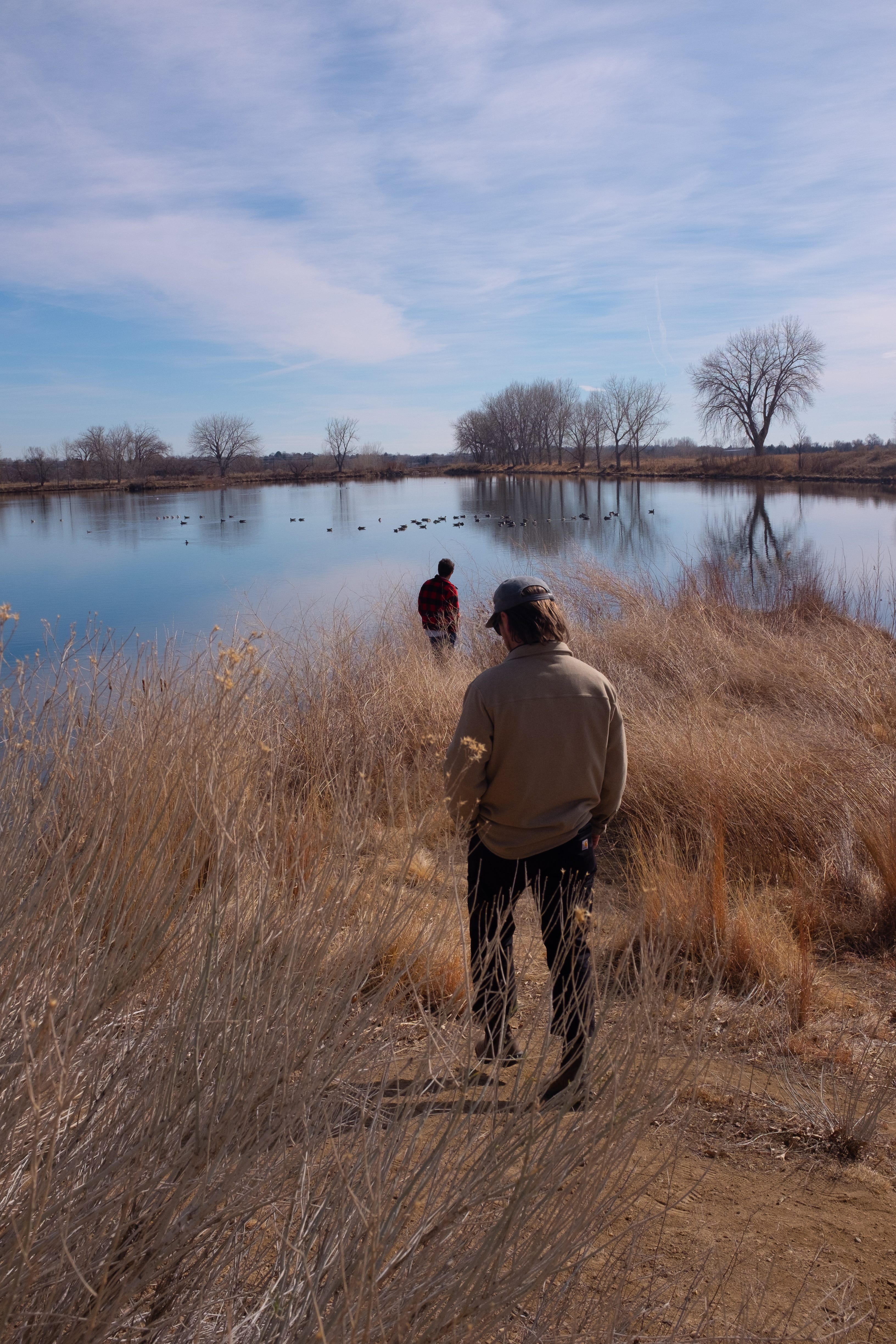
I don’t want to overstep and speak too freely for Chaz (Prymek), but I feel safe in saying he and I share a mutual confusion towards our roles as “songwriters” because neither of us are particularly good at “writing” songs. And yet, now, so many years (maybe like 12-14 years now???) into our friendship and work together as musicians, we have technically written lots and lots of songs together. Our new album Shelter is about friendship, I think. But also, it feels like a statement about our practice, not as composers, but as documentarians.
We didn’t really write these songs… we were dear friends and musicians, and we set up some equipment to record the two of us having a conversation, not as songwriters, but as people who play instruments. Piano and guitar discussing life and death and love and fear and joy and confusion and identity and memories, all wordlessly. Two people playing to and listening for one another.
Without the impulse to record these very special and near-sacred moments of communication, they would never make it past that moment. But we recorded, we added some details after that initial recording, we mixed and edited and cared for those moments, and now they are a record, a document, a thing that you can take with you.
Shelter comes out today on AKP records. You can buy the LP or stream it and download it from bandcamp and all those other places too.
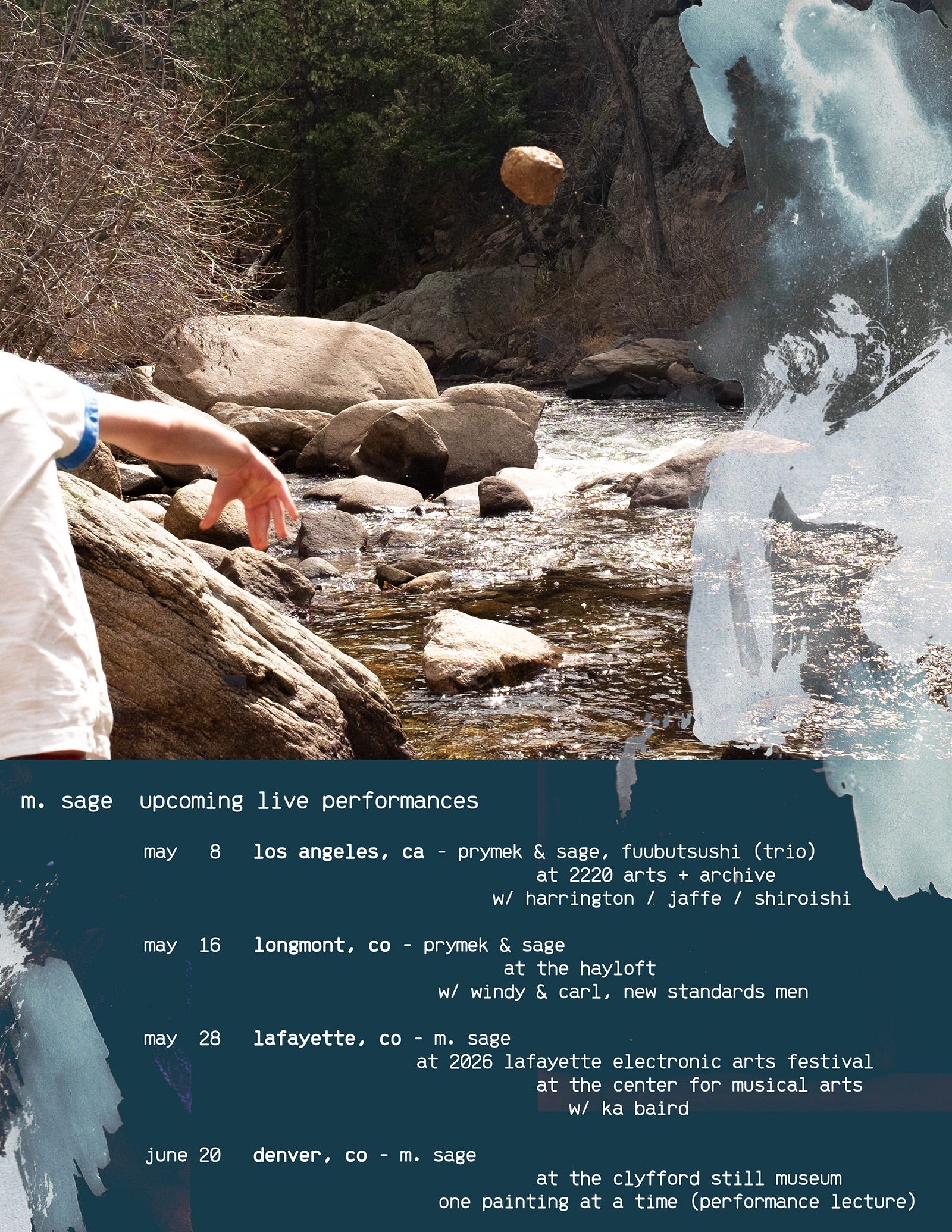
We are playing some shows to support this one! A few Prymek and Sage duos, and also the second ever Fuubutsushi show (our first in trio formation… Chris can’t make this date [we love you Chris!]). These are my first shows in like six months after shoulder surgery and I am really excited to come out and play!!
Tix for all of these, above and below, HERE.
I also have two really cool solo engagements in Colorado coming up. On May 28th I am playing as part of the Lafayette Electronic Art Festival. I am opening for my RVNG labelmate Ka Baird, who is my favorite microphone magician. I am really honored to be part of LEAF, which is a legacy organization doing awesome programming here in Colorado.
I am also doing a One Painting at a Time performance lecture at the Clyfford Still Museum in Denver on June 20th. The Still Museum is one of my favorite museums ever, Clyfford Still is one of my favorite painters ever, and I am preparing a new work for this occasion that is… fun and a little kooky.
I am really looking forward to playing more shows too!
Reach out for booking, or just to say hi, sure! :) ——> hello (at) matthewjsage.com
That is all for today.
For now, From the Tall Grass
-Matt
Thank you for sharing Matt, I have never really thought about music in this way. I feel like I have a better understanding of your work. I am really connected to your words as I was listening to Shelter. Lastly I am really enjoying Andy G video🤌🏾